Myopia Control and Children's Eyes · Eye Health Answers
Children's eyes and myopia control explained
Children rarely complain about their vision, because they assume everyone sees as they do. These pages explain what to watch for, what an eye examination for a child involves and what can be done about short sightedness that is getting worse.
Why children's eyes are checked early
Vision develops through childhood, and the brain learns to use both eyes together during the first years of life. If one eye is blurred, misaligned or obstructed during that period, the brain may not learn to use it properly, a condition called amblyopia or lazy eye. Treatment works well when it starts early and becomes much less effective once visual development is complete.
Short sightedness is a separate issue that usually appears during school years and tends to progress while a child is growing. Higher levels of short sightedness carry a lifelong increase in the risk of retinal problems and glaucoma, which is why slowing progression matters beyond the strength of the glasses.
Signs that a child should be examined
- Sitting very close to the television, or holding books and phones very close
- Screwing up the eyes, tilting the head or covering one eye
- An eye that turns in or out, at any age
- Frequent rubbing, watering, or complaints of headache
- A white or grey reflection in the pupil, or an eye that looks different in photographs, which needs urgent assessment
- Falling behind at school, losing place while reading, or copying from the board with difficulty
- A family history of squint, lazy eye, strong prescriptions or childhood eye disease
What Standard Eye provides
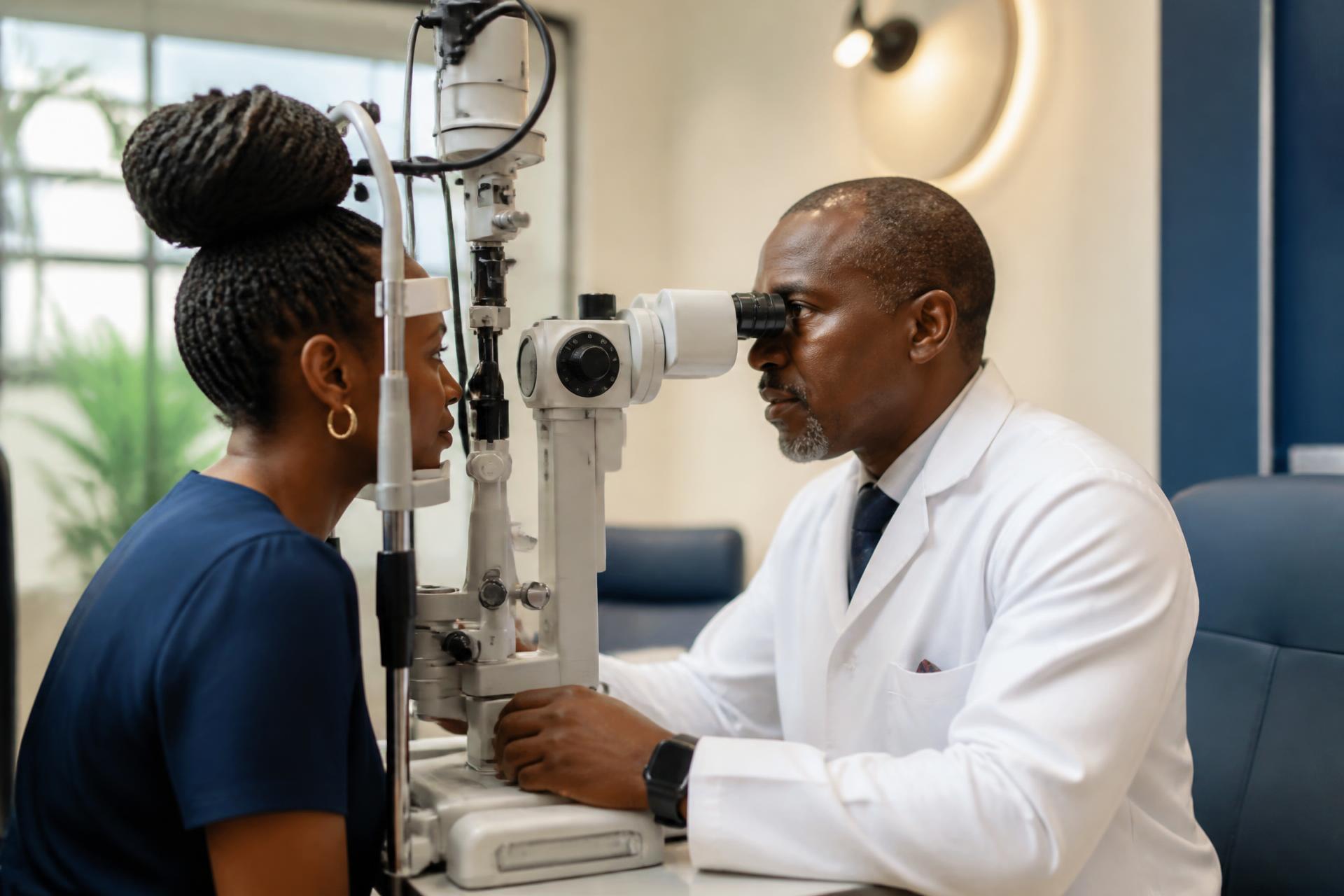
Children's assessment includes age appropriate vision testing, examination of eye alignment and movements, refraction using dilating drops where needed to measure the true prescription, and examination of the front and back of the eyes.
Standard Eye Specialist Hospital offers children's eye examinations, prescription glasses, and myopia control including orthokeratology and repeated low level red light therapy. The clinician will confirm which approach suits your child and how it will be monitored.
Frequently asked questions
- At what age can a child have an eye test?
- At any age. Tests are chosen to suit the child, using pictures, matching games or simply observing how the eyes fix and follow in babies. A child does not need to know letters.
- Will wearing glasses make my child's eyes weaker?
- No. Glasses give the eye a clear image, which is what visual development needs. Leaving a significant prescription uncorrected is what risks harming vision.
- Can short sightedness be reversed?
- No treatment reverses it. Myopia control aims to slow how quickly it increases, which is a different and realistic goal.
Would you like a myopia control and children's eyes assessment?
Request a specialist assessment at our hospital in Garki, Abuja.
You can also read about our myopia control and children's eyes clinic and treatments at Standard Eye Specialist Hospital.
Answers in this topic
Common myopia control and children's eyes questions
Choose the question closest to yours.
What is short sightedness in children?
Short sightedness, or myopia, means distant objects look blurred while near objects are clear.
Read the answerHow can worsening short sightedness be slowed?
Myopia control aims to slow how quickly a child's short sightedness increases, so the eye reaches a lower final prescription.
Read the answerWhat happens at a child's eye examination?
A child's eye examination uses age appropriate tests, so no reading is needed.
Read the answerCould my child's school difficulties be a vision problem?
Yes, sometimes.
Read the answerWhat is a squint in a child?
A squint is a misalignment where one eye turns in, out, up or down rather than pointing with the other.
Read the answer